
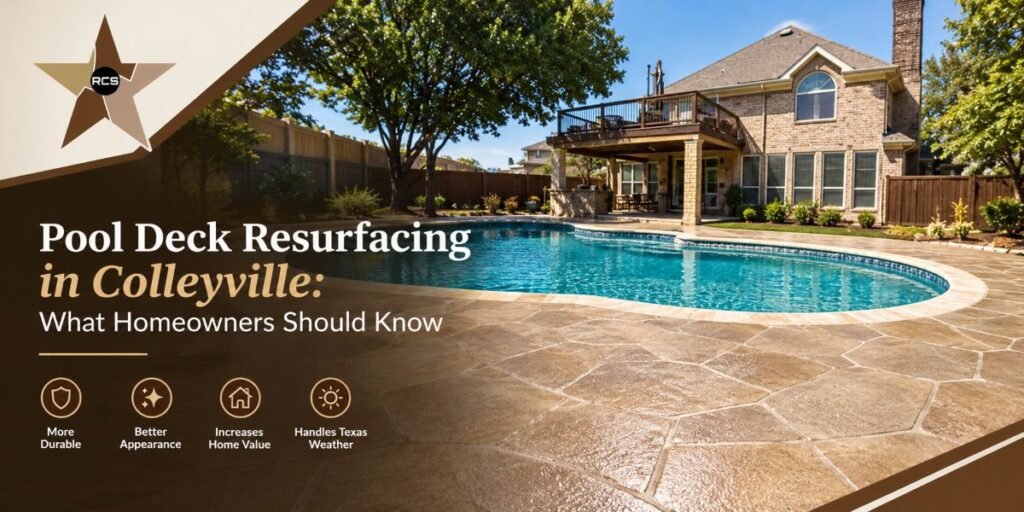
Pool Deck Resurfacing in Colleyville: What Homeowners Should Know
A pool is one of the most valuable parts of a Texas backyard, but the deck surrounding it has to deal with some of the harshest outdoor conditions. Strong sun, high temperatures, rain, pool chemicals, wet feet, and constant foot traffic can gradually leave concrete looking faded, stained, cracked, or uncomfortable to walk across.
For homeowners considering pool deck resurfacing in Colleyville, the good news is that worn concrete does not always need to be demolished and replaced. When the existing surface is structurally suitable, resurfacing can give the pool area a completely different appearance while addressing many common surface problems.
The important part is choosing a resurfacing system based on the condition of the concrete, the demands of the pool environment, and how you actually use the backyard.
What Is Pool Deck Resurfacing?
Pool deck resurfacing involves preparing an existing concrete surface and installing a new decorative overlay or resurfacing system over it.
Rather than removing the entire deck, the existing concrete becomes the base for a new finish. Depending on the system, homeowners can change the surface’s color, texture, pattern, and overall appearance.
This makes resurfacing particularly useful when the deck is structurally sound but has become unattractive or uncomfortable.
Resistant Coating Solutions provides concrete resurfacing and decorative overlay services throughout the Dallas–Fort Worth area, including Colleyville. Its work includes pool decks, patios, driveways, porches, and walkways, with Carvestone overlay systems available for decorative outdoor surfaces.
When Should a Colleyville Pool Deck Be Resurfaced?
Not every damaged pool deck needs the same solution.
Resurfacing may be worth considering when you notice:
- Faded or discolored concrete
- Surface wear from years of use
- Minor cracks and imperfections
- Staining around the pool
- An outdated concrete finish
- A rough or unattractive surface
- A pool area that no longer matches the rest of the backyard
The condition underneath the surface matters most.
If the concrete has major structural movement, extensive settlement, large sections that have broken apart, or serious drainage problems, simply placing an overlay over it may not address the real issue.
A professional assessment should therefore happen before choosing a finish.
Why Colleyville’s Climate Matters
Pool decks in Colleyville have to withstand conditions that can be tough on exterior concrete.
Summer heat can make dark surfaces extremely hot under direct sunlight. UV exposure can affect some finishes over time, while rain and repeated wetting can create additional demands around the pool.
Then there is everyday use. Children running around the pool, adults walking barefoot, outdoor furniture, pets, pool chemicals, and frequent cleaning all contribute to surface wear.
For this reason, a pool deck should not be selected solely on how it looks in a sample.
Ask how the proposed resurfacing system is designed to handle Texas heat, sunlight, moisture, and foot traffic. Resistant Coating Solutions specifically describes its outdoor resurfacing systems as being selected with North Texas conditions in mind.
Safety Should Be Part of the Design
A beautiful pool deck is not very useful if it becomes difficult to walk across safely when wet.
Slip resistance should be considered during the design stage rather than treated as an afterthought.
Textured finishes can provide additional traction around wet areas, although the appropriate texture depends on the specific system and how the pool deck will be used. A surface that offers good grip should still be comfortable enough for bare feet.
This balance is especially important for families with children or older adults.
Resistant Coating Solutions describes its resurfacing options as capable of incorporating textures intended to provide improved traction, making the finish particularly relevant to pool decks and other areas exposed to water.
For homeowners, the useful question is not simply, “Is it non-slip?” Instead, ask what texture will be used, how it feels under bare feet, and how it performs when the surface is wet.
Carvestone Overlay for a More Natural Look
One option available from Resistant Coating Solutions is a Carvestone overlay.
Carvestone-based systems can create a natural-stone-inspired appearance without requiring homeowners to remove an entire existing concrete deck. The company’s published information describes a combination of natural Carvestone, cement, and polymer, with patterns that can be hand-carved rather than produced using conventional stamping tools.
That approach can create a more individual appearance.
Depending on the home’s architecture and existing landscaping, the finished design can be selected to resemble different types of stone, tile, or other decorative patterns.
This can be particularly useful in Colleyville homes where the pool area is designed as an extension of the property’s outdoor living space rather than simply a functional swimming area.
Choosing the Right Color and Texture
Color matters more around a pool than many homeowners initially realize.
A very dark surface can absorb substantial heat under direct Texas sunlight. Lighter finishes can be more comfortable in sunny areas, although the final performance depends on the material, color, texture, exposure, and installation.
Instead of selecting a color from a small indoor sample, look at samples outdoors if possible.
Consider how the finish looks beside:
- Brick or stone on the house
- Pool coping
- Landscaping
- Outdoor furniture
- Fencing
- Patio covers
- Existing walkways
A simple neutral finish can often remain attractive for years, while an overly specific color or pattern may eventually feel dated.
If you want to coordinate multiple areas, concrete patio resurfacing services can also be considered when updating adjacent outdoor concrete.
What Happens During Pool Deck Resurfacing?
A quality resurfacing project starts long before the new finish is visible.
Surface Assessment
The existing pool deck is examined to determine whether it is suitable for resurfacing. Cracks, damaged sections, stains, drainage concerns, and other imperfections need to be identified.
Surface Preparation
Preparation is arguably the most important part of the installation.
The existing surface must be properly cleaned and prepared so the new system can bond effectively. Minor defects may need repair before the overlay is installed.
This is one area where homeowners should be cautious about choosing a contractor based solely on price. An inexpensive finish applied over poorly prepared concrete can create problems later.
Overlay Installation
After preparation, the selected resurfacing system is applied according to the planned design.
For a Carvestone project, the finish can be shaped and carved to create a natural-stone-inspired pattern. The final appearance depends on the selected color, texture, pattern, and craftsmanship.
Final Curing and Use
The completed surface needs appropriate time before normal pool traffic resumes. The exact timeframe depends on the system, weather, project size, and installation conditions.
Your contractor should tell you when the deck can safely handle foot traffic, furniture, cleaning, and normal pool use.
Can Resurfacing Cover Cracked Concrete?
It can address certain existing surface imperfections, but homeowners should understand the difference between covering a visible crack and solving the reason the concrete cracked.
Minor cracks may be incorporated into a decorative pattern or addressed during preparation. Resistant Coating Solutions notes that existing cracks can be incorporated into the pattern design of its overlay system so they blend into the finished appearance.
However, serious structural movement is different.
If a section of concrete is sinking, shifting, or experiencing significant structural failure, an overlay should not be viewed as a universal fix. The underlying problem needs to be evaluated first.
That is why a proper site assessment is more valuable than simply choosing a finish from photographs.
How Long Can Pool Deck Resurfacing Last?
Longevity depends on several factors, including the existing concrete, preparation quality, materials, installation, climate, traffic, and maintenance.
Resistant Coating Solutions’ published information indicates that professionally installed and properly maintained Carvestone resurfacing can potentially last many years, with some of its material discussing service life of 15–20 years or longer depending on conditions.
That should be treated as an expected-performance range rather than a guarantee for every property.
Good maintenance still matters. Keep the surface clean, address damage early, follow the manufacturer’s maintenance recommendations, and avoid using unsuitable chemicals or cleaning methods.
Resurfacing or Replacing the Pool Deck?
This is one of the most important decisions to make before starting the project.
| Consideration | Resurfacing | Full Replacement |
|---|---|---|
| Existing slab | Needs to be suitable | Removed and rebuilt |
| Demolition | Limited compared with replacement | Significant |
| Design change | Yes | Yes |
| Project disruption | Generally lower | Generally greater |
| Best use | Sound concrete with surface issues | Major structural problems |
| Decorative options | Multiple finishes available | Multiple finishes available |
If your pool deck is fundamentally stable but looks tired, resurfacing may offer a practical middle ground.
If the slab has widespread structural problems, however, rebuilding may be the more appropriate long-term solution.
Questions to Ask Before Hiring a Resurfacing Contractor
Before signing a contract, ask:
- Is my existing pool deck structurally suitable for resurfacing?
- How will cracks and damaged areas be prepared?
- What overlay system will you use?
- What texture is recommended for a wet pool environment?
- How will the finish handle Colleyville’s heat and sun?
- What colors and patterns are available?
- How long will installation take?
- When can people safely walk on the finished surface?
- What maintenance does the surface require?
- What problems would make replacement a better option?
These questions can help you compare proposals based on the actual work involved rather than just the final price.
Why Local Experience Matters in Colleyville
A pool deck is an outdoor surface, so local conditions should influence material selection and installation decisions.
Colleyville is part of the Dallas–Fort Worth region, where intense summer heat and strong sun are normal considerations for outdoor concrete. A contractor familiar with North Texas conditions can help homeowners think about surface temperature, UV exposure, drainage, texture, and long-term maintenance before installation begins.
Resistant Coating Solutions lists Colleyville among its Dallas–Fort Worth service areas and focuses specifically on decorative concrete resurfacing and overlay solutions for North Texas homes.
If your project includes other aging concrete areas, it may also be useful to review driveway resurfacing solutions or decorative concrete overlay options when planning a larger exterior upgrade.
Final Thoughts
A worn pool deck does not necessarily mean the entire concrete surface needs to be removed. When the existing slab is stable, pool deck resurfacing in Colleyville can provide a practical way to improve appearance, texture, comfort, and usability without the disruption of complete replacement.
The strongest projects begin with an honest assessment of the existing concrete. From there, homeowners can choose a finish based on safety, heat exposure, design, maintenance, and the way the pool is actually used.
For Colleyville properties, a well-chosen decorative overlay can turn an aging concrete deck into a more comfortable and visually connected part of the backyard—while keeping the focus where it belongs: a surface that looks good and performs well in the demanding North Texas climate.